16–17 Jan 2023Appointment
A surprise choice
Christine Lambrecht resigns after months of criticism. Chancellor Scholz names Pistorius, then little known nationally, as her successor.
In peacetime the Federal Minister of Defence commands the Bundeswehr. The Bundestag decides when it may be deployed and what it may spend. Pistorius has held this office since 19 January 2023.
A The constitutional framework
Germany’s post-war constitution was written to make the armed forces a firmly civilian-controlled, parliamentary institution. These provisions define the minister’s job.
Article 87a
The Federation builds up armed forces for defence. Their numerical strength and organisation must be visible in the federal budget, so parliament controls their size through the budget.
Article 65a
Command authority over the armed forces lies with the Federal Minister of Defence. This makes the minister, not a general, the head of the military chain of command in peacetime.
Articles 115a–115b
If Germany is attacked, the Bundestag, with the Bundesrat’s consent, declares a state of defence, and command passes to the Chancellor.
Article 45a
The Bundestag must maintain a Defence Committee, which has the unique right to constitute itself as a committee of inquiry at any time.
Article 45b
A Parliamentary Commissioner for the Armed Forces (Wehrbeauftragte) protects soldiers’ rights and reports annually to parliament on the state of the Bundeswehr. These reports often contain criticism of the ministry.
Article 24(2)
Germany may join systems of mutual collective security such as NATO and the UN. This is the legal basis for deployments abroad within those frameworks.
B The parliamentary army
The Bundeswehr is often called a Parlamentsarmee, a parliamentary army. In a landmark judgment on 12 July 1994, the Federal Constitutional Court ruled that every deployment of armed forces abroad requires the prior, constitutive approval of the Bundestag. The rule was codified in the Parliamentary Participation Act of 2005.
In practice, the government proposes a mandate setting out the mission, the area of operations, the maximum number of soldiers and the duration. The Bundestag votes it up or down. The minister cannot send troops into armed operations on his own authority, except in an emergency, when approval must be sought immediately afterwards.
Parliament’s control extends to money. Any procurement worth more than €25 million must be presented to the Bundestag’s budget committee, which is why large purchases are publicly visible as “€25 million submissions”. The Bundeswehr also follows the principle of Innere Führung, “leadership development and civic education”: soldiers are “citizens in uniform” who keep their basic rights.
C The ministry
Political leadership
The minister is supported by parliamentary state secretaries and permanent state secretaries who run the ministry’s divisions on policy, planning, personnel, budget, equipment, infrastructure and cyber/IT.
Military leadership
The Chief of Defence is the highest-ranking soldier and the minister’s principal military adviser. Since the 2024 reform, an Operational Command in Berlin leads national and alliance operations.
Procurement
Equipment is bought through the Federal Office of Bundeswehr Equipment, Information Technology and In-Service Support (BAAINBw) in Koblenz, the focus of repeated reform efforts.
Personnel
Recruitment, careers and reservists, including the new military service: questionnaires, medical screening and voluntary service since January 2026.
International
Representing Germany in NATO and EU defence formats, bilateral partnerships and, since 2025, co-chairing the Ukraine Defence Contact Group.
D The tenure
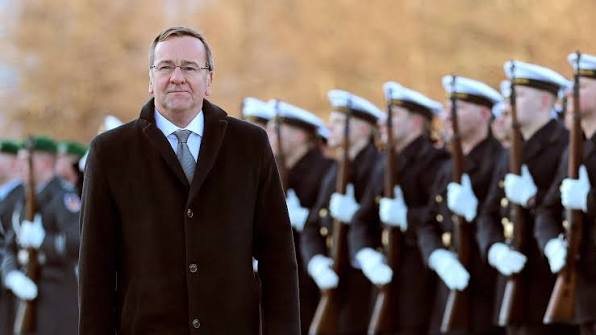
16–17 Jan 2023Appointment
Christine Lambrecht resigns after months of criticism. Chancellor Scholz names Pistorius, then little known nationally, as her successor.
19–20 Jan 2023First days
He takes the oath of office in the Bundestag and receives US Defense Secretary Lloyd Austin in Berlin the same day. On 20 January he attends the Ukraine Defence Contact Group at Ramstein Air Base.
25 Jan 2023Ukraine
The government approves 14 Leopard 2A6 tanks for Ukraine. Pistorius travels to Panzerbataillon 203 in Augustdorf to tell the soldiers that their tanks will go to Ukraine.
Mar 2023Leadership
He replaces General Eberhard Zorn with General Carsten Breuer, who had led the federal government’s Covid-19 crisis staff, signalling a focus on speed and organisation.