Boris PistoriusDefence · Politics · Europe
10 · Major decisions

Decision files, 2023–2026

Ten decisions that shaped the tenure, each set out the same way: what was decided, the context, Pistorius’s role, the criticism and what happened next. Some were taken by the whole government or by the Chancellor; the files say so.

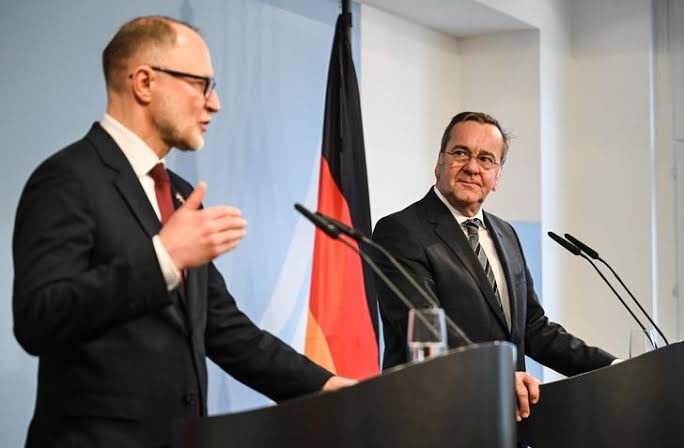
Boris Pistorius standing at a lectern listening as a European counterpart speaks at a joint press conference, with the German flag behind them
Fig. 1Pistorius at a joint press conference with a European counterpart at the Federal Ministry of Defence.

01

25 January 2023

Ukraine · Government decision

Leopard 2 tanks for Ukraine

Decision
Germany sends a company of 14 Leopard 2A6 tanks from Bundeswehr stocks and authorises partners to re-export their German-made Leopards, with the aim of equipping two Ukrainian tank battalions.
Context
Months of pressure from Kyiv and allies; Germany had insisted on acting together with the United States, which simultaneously announced Abrams tanks.
His role
The decision was the Chancellor’s, announced six days after Pistorius took office. He carried out the delivery and personally informed Panzerbataillon 203 in Augustdorf.
Criticism
Allies and German critics said the decision came too late; others warned of escalation with Russia.
Afterwards
The first German Leopards reached Ukraine in March 2023. Germany ordered new Leopard 2A8 tanks to replace them.

02

26 June 2023

NATO · Ministerial initiative

A permanent brigade in Lithuania

Decision
In Vilnius, Pistorius announces that Germany is ready to station a combat brigade of around 4,000–5,000 troops permanently in Lithuania.
Context
Germany had led NATO’s multinational battlegroup in Lithuania since 2017. The Baltic states sought a larger, permanent allied presence after 2022.
His role
Central. He made the announcement and signed the bilateral roadmap with Lithuania on 18 December 2023.
Criticism
Questions over cost, family accommodation and whether enough soldiers would volunteer to move.
Afterwards
Panzerbrigade 45 was formally established on 1 April 2025 and held its stand-up parade in Vilnius on 22 May 2025 with Chancellor Merz. Full operational capability is planned for the end of 2027.

03

28 September 2023

Air defence · Procurement

Buying Arrow 3 from Israel

Decision
Germany signs a multi-billion-euro contract for the Israeli-US Arrow 3 system to intercept long-range ballistic missiles.
Context
A gap in Germany’s defence against ballistic missiles, and the European Sky Shield Initiative launched by Chancellor Scholz in 2022.
His role
Signed the agreement in Berlin with Israel’s defence ministry and championed the fast timeline.
Criticism
France and others preferred European systems; some experts questioned the priority given to exo-atmospheric interception.
Afterwards
Initial operational capability was declared on 3 December 2025 at Holzdorf, the first Arrow deployment in Europe.

04

9 November 2023

Doctrine

New Defence Policy Guidelines

Decision
National and alliance defence becomes the organising task of the Bundeswehr; “war-fitness” becomes the yardstick.
Context
Ten days earlier, on 29 October 2023, he had told ZDF that Germany must become kriegstüchtig.
His role
Author and public face of the guidelines.
Criticism
The vocabulary was criticised as militaristic, including by some in the SPD.
Afterwards
The guidelines framed the 2024 restructuring and the personnel targets in the military service law.

05

30 April 2024

Structure

The Osnabrück Decree

Decision
A new command structure: one Operational Command, and cyber and information space as a fourth branch of service. Principles announced on 4 April; decree effective 1 May 2024.
Context
The previous 2012 structure was built for missions abroad rather than defence of NATO territory.
His role
Signed the decree, which is named after his home city.
Criticism
Some experts called it overdue but limited, as structures alone do not fix procurement or personnel.
Afterwards
The Bundeswehr Operational Command was set up on 1 October 2024.

06

10 July 2024

Deterrence · Government decision

US long-range missiles in Germany

Decision
A joint US–German announcement at NATO’s Washington summit: episodic deployments of US long-range fires in Germany from 2026.
Context
Russia’s deployment of intermediate-range systems and the end of the INF Treaty in 2019.
His role
Defended the decision publicly as closing a serious gap in deterrence until Europe develops comparable systems of its own.
Criticism
Parts of the SPD, the Left and the BSW warned of a new arms race and criticised the lack of parliamentary debate.
Afterwards
European partners launched work on a European long-range strike capability.

07

February 2025

Ukraine · Coalition leadership

Co-chairing the Ukraine Defence Contact Group

Decision
From the meeting at NATO headquarters on 12 February 2025, the United Kingdom and Germany chair the “Ramstein” group of around 50 countries, a role previously held by the United States.
Context
The new US administration signalled that Europe should take the lead in supporting Ukraine.
His role
Co-chair with UK Defence Secretary John Healey.
Criticism
Some argued Europe still lacked the production capacity to replace US support.
Afterwards
At the April 2025 meeting, partners pledged a record of around €21 billion in military aid.

08

24–25 June 2025

NATO · Allied decision

The Hague spending commitment

Decision
Allies commit to 5% of GDP by 2035: 3.5% on core defence and 1.5% on related spending.
Context
Pressure from the US administration and NATO’s new capability targets.
His role
Had cautioned against focusing on percentages rather than capabilities, then backed the outcome and set out a path of about 0.2 percentage points a year.
Criticism
Questions about affordability alongside social spending, and about the definition of “related” spending.
Afterwards
Budgets of €82.7 billion (2026) and a request of €109.7 billion (2027) for the regular defence budget.

09

13 Nov – 5 Dec 2025

Personnel · Legislation

The new military service

Decision
Voluntary service based on the Swedish model, with mandatory questionnaires and medical screening for men born from 2008, annual growth targets, and a needs-based draft only by decision of the Bundestag.
Context
Conscription had been suspended since 2011. Pistorius presented his model in June 2024; the cabinet adopted the bill on 27 August 2025.
His role
Author of the bill. In October 2025 he opposed a lottery model negotiated by coalition specialists, which caused open conflict with the Union and parts of his own group.
Criticism
The Union wanted more compulsion; youth organisations and the Left objected to compulsory screening; others doubted volunteers would suffice.
Afterwards
Compromise on 13 November 2025; passed by the Bundestag on 5 December 2025; in force from 1 January 2026.

10

4 October 2026

Capability

The first drone regiment

Decision
The army will set up its first drone regiment from 2027 under the 10th Armoured Division, combining attack and reconnaissance drones, unmanned ground systems, counter-drone and electronic warfare.
Context
Lessons from Ukraine, where drones have transformed the battlefield.
His role
Announced it at the Bergen training area: “The drone regiment will complement our innovation ecosystem.” (translation)
Criticism
Too early to assess; critics of procurement point to the need to buy drones in volume and quickly.
Afterwards
Units from light infantry, reconnaissance and armoured forces begin introducing unmanned systems from the turn of 2026/27.