Boris PistoriusDefence · Politics · Europe
13 · International security

The threat picture, as he describes it

Five security themes that recur in Pistorius’s speeches, interviews and decisions. Each is presented with his documented position and the context needed to judge it.

01
Russia
02
Hybrid threats & cyber
03
Indo-Pacific & China
04
Middle East
05
Defence technology
Russia

Preparing for the worst case

No theme defines Pistorius’s tenure more than Russia. Germany’s 2023 National Security Strategy names Russia as the most significant threat to peace and security in the Euro-Atlantic area. In January 2024 he told the Berlin daily Der Tagesspiegel that, given threats from the Kremlin, one had to take into account that Vladimir Putin might one day attack a NATO country, and that experts expected a period of five to eight years in which this could become possible.

The remark was cited in Germany and abroad as a sign of a sharper German threat assessment; critics accused him of alarmism. It has shaped his argument that the Bundeswehr must be ready by the end of the decade, a target date he has since repeated, including in a television interview naming 2029.

His own view of Russia changed. As Lower Saxony’s interior minister he suggested in 2018 that sanctions imposed after the annexation of Crimea should be reviewed. After the invasion of 2022 he described the earlier hope of change through engagement as an illusion.
Hybrid threats & cyber

Below the threshold of war

Hybrid threats are hostile actions that stop short of open war: disinformation, cyber-attacks, sabotage, espionage and drones over military sites. Pistorius has framed several incidents in these terms. When Russian media published an intercepted Luftwaffe call in March 2024, he called it “a hybrid disinformation attack” aimed at dividing Germany and its allies.

His structural answer was the 2024 Osnabrück Decree, which made cyber and information space a separate branch of the Bundeswehr. German media have also reported drones apparently spying on arms transports bound for Ukraine. Protecting military infrastructure inside Germany has become a growing concern of the ministry.

Lesson of the leak: the officers’ call took place over Webex, and one participant had dialled in from a hotel in Singapore over an insecure connection. Pistorius described it as an individual error, not a systemic failure, a view some critics disputed.

Indo-Pacific & China

A European power in Asian waters

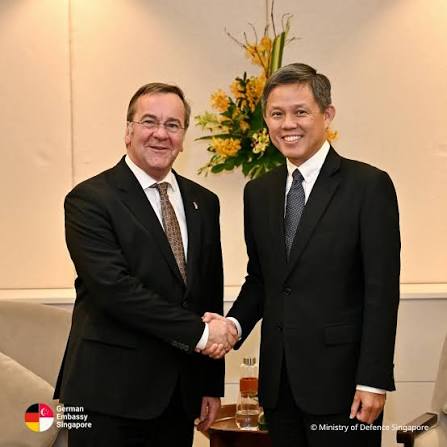
Germany published Indo-Pacific guidelines in 2020 and has since sent naval deployments to the region. Pistorius has visited India (June 2023) and Singapore, where he has addressed the Shangri-La Dialogue, Asia’s main defence forum. In August 2024 Germany joined the United Nations Command in South Korea, and he announced plans for a defence cooperation agreement with the Philippines.

In September 2024 two German navy ships transited the Taiwan Strait, the first such passage by German warships in more than two decades. Pistorius defended the route as passage through international waters; China criticised it. His approach to China has been framed around freedom of navigation and the rules-based order rather than direct confrontation.

Boris Pistorius shaking hands with Singapore's Minister for Defence Chan Chun Sing in front of a floral arrangement
Fig. 1With Singapore’s Minister for Defence, Chan Chun Sing. Photo: Ministry of Defence Singapore.
Middle East

Israel, the Red Sea and arms exports

After the Hamas attack on Israel on 7 October 2023, Pistorius expressed Germany’s full support for Israel and offered material support. Germany’s purchase of Israel’s Arrow 3 system, signed a week before the attack, made the two countries’ defence relationship closer than ever.

In 2024 the German navy took part in the EU’s Aspides mission to protect merchant shipping in the Red Sea against Houthi attacks, under a mandate approved by the Bundestag. As the war in Gaza continued, German arms exports to Israel became the subject of intense domestic and international debate, and in August 2025 the federal government restricted exports of weapons that could be used in Gaza.

Defence technology

Drones, interceptors and research

The war in Ukraine has changed the defence-technology agenda: cheap drones, electronic warfare and layered air defence matter as much as tanks and aircraft. Under Pistorius the Bundeswehr has introduced the Arrow 3 exo-atmospheric interceptor, financed Ukrainian drone production and announced its first drone regiment.

The 2027 budget request contains the first dedicated programme to fund defence research at civilian universities, in fields such as artificial intelligence and unmanned systems.

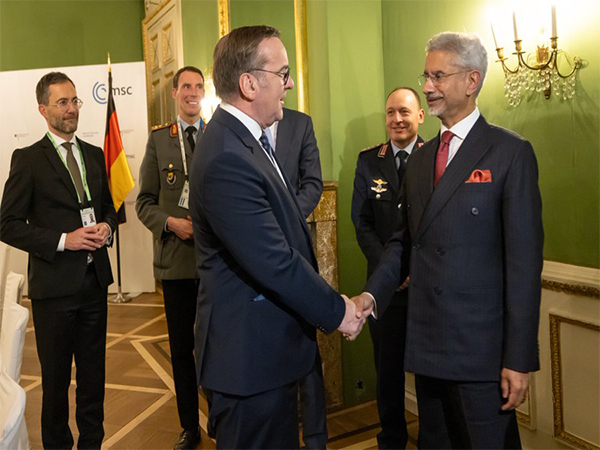
Boris Pistorius shaking hands with India's External Affairs Minister S. Jaishankar in a green-walled room at the Munich Security Conference, with officers looking on
Fig. 2With India’s External Affairs Minister S. Jaishankar on the sidelines of the Munich Security Conference, February 2025.

06 Forums

Where the arguments are made

The Munich Security Conference is the most important annual stage for German security policy, and Pistorius has sat on its advisory council since 2023. Other recurring venues include NATO and EU defence ministers’ meetings, the Shangri-La Dialogue in Singapore and the Ukraine Defence Contact Group.

International engagement