Boris PistoriusDefence · Politics · Europe
08 · German defence policy

From Zeitenwende to a funded defence policy

A plain-English briefing on how Germany decides what its armed forces are for, how much it spends on them and how that has changed since 2022.

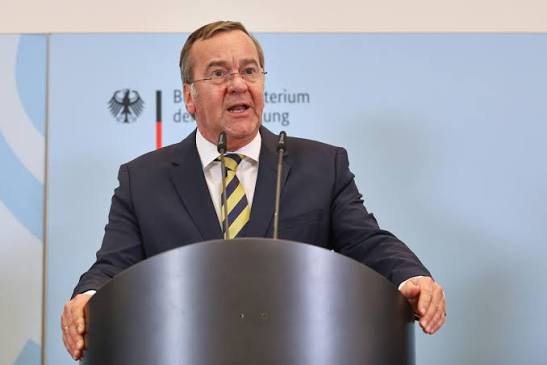
Boris Pistorius speaking at a lectern in front of the Federal Ministry of Defence logo
Fig. 1Pistorius briefing the press at the Federal Ministry of Defence.

A The turning point

What “Zeitenwende” means

On 27 February 2022, three days after Russia launched its full-scale invasion of Ukraine, Chancellor Olaf Scholz told the Bundestag that the world had reached a Zeitenwende, a turning point. He announced a €100 billion special fund for the Bundeswehr and a commitment to NATO’s target of spending at least two per cent of GDP on defence.

The special fund was anchored in the Basic Law through a new Article 87a(1a), approved by the Bundestag on 3 June 2022 with the votes of the coalition and the CDU/CSU opposition. Its purpose was to close equipment gaps accumulated over three decades in which the Bundeswehr had shrunk and been organised around missions such as Afghanistan rather than the defence of NATO territory.

Pistorius inherited this framework eleven months later. His contribution has been less in announcing the turn than in insisting on its consequences: that a funded, ready army needs a permanent rise in the regular budget, not a one-off fund; that it needs people, not only equipment; and that society must be prepared to think about defence again.

“Wir müssen kriegstüchtig werden.” We must become fit for war.Boris Pistorius, ZDF Berlin direkt, 29 October 2023 (translation)

B Defence spending

How the money works

German defence money comes from two sources: the regular budget of the defence ministry (known as section 14 of the federal budget) and the special fund created in 2022. Since March 2025, defence spending above 1% of GDP is also exempt from the constitutional debt brake.

Regular defence budget (section 14), € billion

Core budget
202451.95
202562.4
202682.7
2027 (request)109.7

Federal budgets as adopted; 2027 is the government’s request presented in September 2026. Special-fund money comes on top (about €25.5 billion in 2026 and about €30 billion requested for 2027).

Special fund

€100bn

Created in 2022 for major equipment, including F-35 fighters, CH-47 heavy-lift helicopters and the Arrow 3 system. Largely committed by 2027.

Bundeswehr Special Fund Act, 2022

NATO benchmark, 2014–2025

2% of GDP

Agreed at the Wales summit in 2014. Germany reached it in 2024 for the first time since the early 1990s, according to NATO estimates, with help from the special fund.

NATO defence expenditure reports

NATO target from 2025

3.5 + 1.5%

At The Hague on 24–25 June 2025, allies agreed to spend 3.5% of GDP on core defence and up to 1.5% on related infrastructure and resilience by 2035.

The Hague Summit Declaration

Debt brake reform

Mar2025

Before the new Bundestag met, the outgoing parliament amended the Basic Law (18 March; Bundesrat 21 March) so that defence spending above 1% of GDP no longer counts against the borrowing limit.

Basic Law, Article 109 and 115

C Doctrine

The documents that define the policy

14 Jun 2023Strategy

First National Security Strategy

The Scholz government publishes Germany’s first comprehensive National Security Strategy, built around “integrated security”: defence, resilience and sustainability. It identifies Russia as the most significant threat to peace and security in the Euro-Atlantic area.

9 Nov 2023Guidelines

Defence Policy Guidelines

Pistorius presents new Defence Policy Guidelines (Verteidigungspolitische Richtlinien), the Bundeswehr’s highest-level planning document. National and collective defence becomes the central task, and “war-fitness” the standard by which the forces are measured.

30 Apr 2024Structure

The Osnabrück Decree

A new top-level structure: a single Operational Command (established 1 October 2024), clearer lines between the ministry and the forces, and cyber and information space as a fourth service alongside army, air force and navy.

1 Jan 2026Personnel

Military Service Modernisation Act

The new military service law enters into force: voluntary service with mandatory questionnaires and medical screening for young men, and a parliamentary route to a needs-based draft if targets are missed.

D The debates

Where defence policy is contested

Percentages or capabilities?

Before the Hague summit, Pistorius cautioned against fixating on headline percentages and argued that the measure should be the capabilities NATO asks of Germany. Germany then endorsed the 3.5 + 1.5 formula. He has since presented a roadmap that raises defence spending by about 0.2 percentage points of GDP a year. Critics on the left question whether such sums are affordable; critics on the right question whether the ministry can spend them efficiently.

US long-range weapons in Germany

On 10 July 2024, at NATO’s Washington summit, the United States and Germany announced that US long-range fires, including SM-6, Tomahawk and developmental hypersonic missiles, would be deployed episodically in Germany from 2026. Pistorius defended the plan as closing a gap in deterrence; parts of the SPD, including then parliamentary group leader Rolf Mützenich, warned of escalation.

Debt and the budget

Under the traffic-light coalition, the debt brake set hard limits. In July 2024 Pistorius received far less than the extra €6.5 billion he had requested for 2025 and said publicly that the result was not what the forces needed. The 2025 reform removed that constraint for defence, shifting the debate from “how much” to “how fast”.

Society and the language of war

His call for Germany to become kriegstüchtig divided opinion. Supporters saw overdue honesty about the threat; critics, including some Social Democrats, preferred “defence-capable” (verteidigungsfähig) and warned against militarising public debate. See Controversies