Boris PistoriusDefence · Politics · Europe
05 · Lower Saxony

Seventeen years of regional government

Before Berlin there was Lower Saxony, Germany’s second-largest state by area: seven years as Lord Mayor of Osnabrück and almost ten as the state’s Minister for the Interior and Sport.

Places in Boris Pistorius's Lower Saxony career A schematic plotted by latitude and longitude showing Osnabrück, where he was Lord Mayor; Hanover, the state capital where he was Interior Minister; Achim, where he did military service; Oldenburg, seat of the regional administration where he worked; and the Bergen training area, where he announced a drone regiment in 2026. 7°E8°E9°E10°E11°E 53°N52°N Emden Wilhelmshaven Oldenburg Achim Lüneburg Bergen training area Braunschweig Göttingen Osnabrück Hanover
Schematic plotted to scale by latitude and longitude; state borders are not drawn. Amber marks Osnabrück, blue marks the state capital, Hanover.

A The places

A career mapped onto one state

Every stage of Pistorius’s life before 2023, from school to state cabinet, took place within Lower Saxony.

  1. 1
    Osnabrück

    Birthplace, school, city council from 1996, Lord Mayor 2006–2013 and his Landtag constituency, Osnabrück-West, from 2017 to 2023.

  2. 2
    Achim

    Conscript service with Air Defence Regiment 11 at the Steuben barracks, 1980–81.

  3. 3
    Oldenburg

    Legal clerkship in the Higher Regional Court district; later senior posts in the Weser-Ems regional administration.

  4. 4
    Hanover

    The state capital: adviser in the interior ministry 1991–1996, Interior Minister 2013–2023, and since 2025 his Bundestag constituency, Hannover II.

  5. 5
    Bergen

    One of the Bundeswehr’s largest training areas, where in October 2026 he announced the army’s first drone regiment.

B 2006–2013

Lord Mayor of Osnabrück

In Lower Saxony the Lord Mayor (Oberbürgermeister) of a large city is directly elected and serves as full-time head of the municipal administration and chair of its executive committee. Pistorius won the post in a run-off on 24 September 2006, defeating the CDU’s Wolfgang Griesert with about 55 per cent, and took office on 7 November 2006.

His tenure covered the aftermath of the 2008–09 financial crisis, when German municipalities faced pressure on business-tax revenue and social spending.

Lord Mayors also represent their city externally. For Osnabrück that means its self-image as the City of Peace, rooted in the 1648 Peace of Westphalia, and its long relationship with the British Army, which maintained a garrison there until 2009.

He left office in February 2013, before the end of his term, to join the new state cabinet in Hanover. In 2025 his home city awarded him its Justus Möser Medal.

C 2013–2023

Minister for the Interior and Sport

A state interior minister in Germany runs the police, the state office for the protection of the constitution, civil protection and local-government supervision. Lower Saxony’s ministry also covers sport. These were the defining files of his decade.

2015–2016Migration

Receiving refugees

When more than a million asylum seekers reached Germany, the interior ministry was responsible for state reception centres and for working with municipalities on housing and registration. Lower Saxony receives just under a tenth of asylum seekers under the federal distribution key.
Feb 2017Counter-terrorism

First use of a deportation order against Islamist “endangerers”

Lower Saxony became the first state to use Section 58a of the Residence Act, which allows the deportation of foreign nationals considered a particular security threat. The orders against two men from Göttingen were upheld by the Federal Administrative Court in March 2017.

2018–2019Police law

A new police law, and protests

The SPD–CDU coalition reformed the state’s police and public-order law, extending powers such as preventive detention of terror suspects and electronic tagging. Civil-liberties groups, opposition parties and many young people demonstrated against it in Hanover in 2018. The Landtag passed the law in 2019.

2021Extremism online

Pressure on Telegram

During the pandemic, as conspiracy movements and extremists organised on Telegram, Pistorius called for the messaging service to be banned in Germany if it would not act against extremist content.

Dec 2022Right-wing extremism

A sharp line on the AfD

Pistorius described much of the Alternative for Germany as right-wing extremist and compared its methods to those of the National Socialists. The remark was criticised by the AfD and welcomed by many in his party.

On Russia, his views changed over the decade. In 2018 he suggested reviewing sanctions imposed after the annexation of Crimea; after the full-scale invasion of 2022 he described earlier hopes of change through engagement as an illusion. See Political positions.

What Hanover prepared him for

Commentators have often noted that the interior ministry is good preparation for defence. Both are large, hierarchical security organisations with uniformed personnel, demanding procurement and constant political scrutiny. Pistorius arrived in Berlin used to dealing with police unions, staff representatives, budget committees and crises that break overnight.

He also arrived as an outsider to federal defence circles, which helped him present himself as a minister without the baggage of past procurement failures.

Next: federal politics

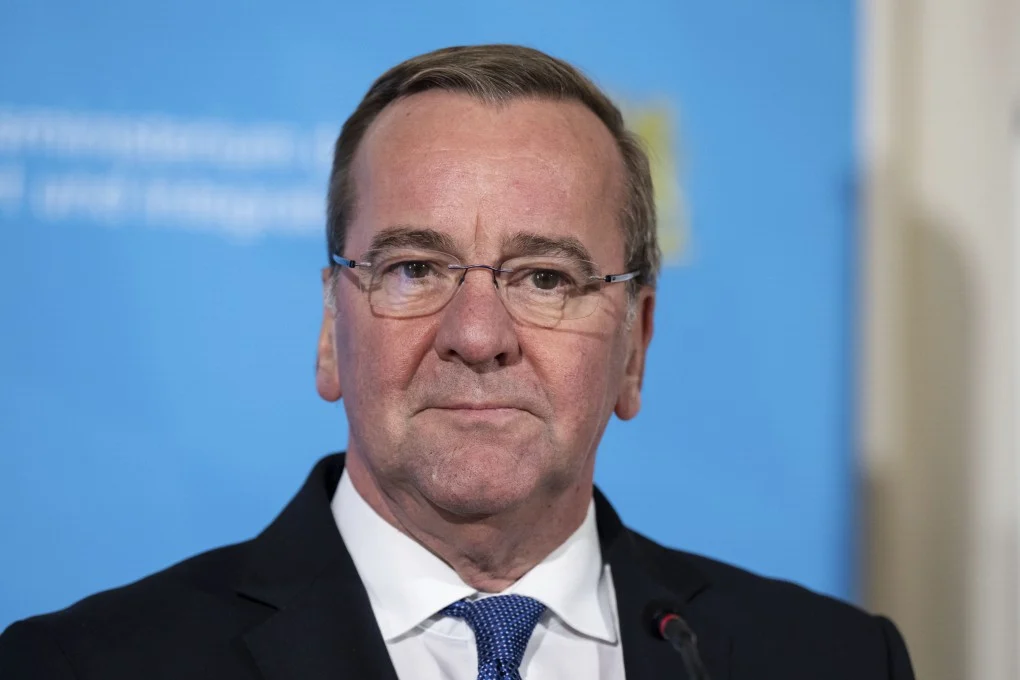
Boris Pistorius at a press conference in front of a blue backdrop with a microphone in the foreground
Fig. 1Pistorius at a press conference. As a state interior minister he was a frequent presence at the podium during security incidents.