Germany’s place in the alliance
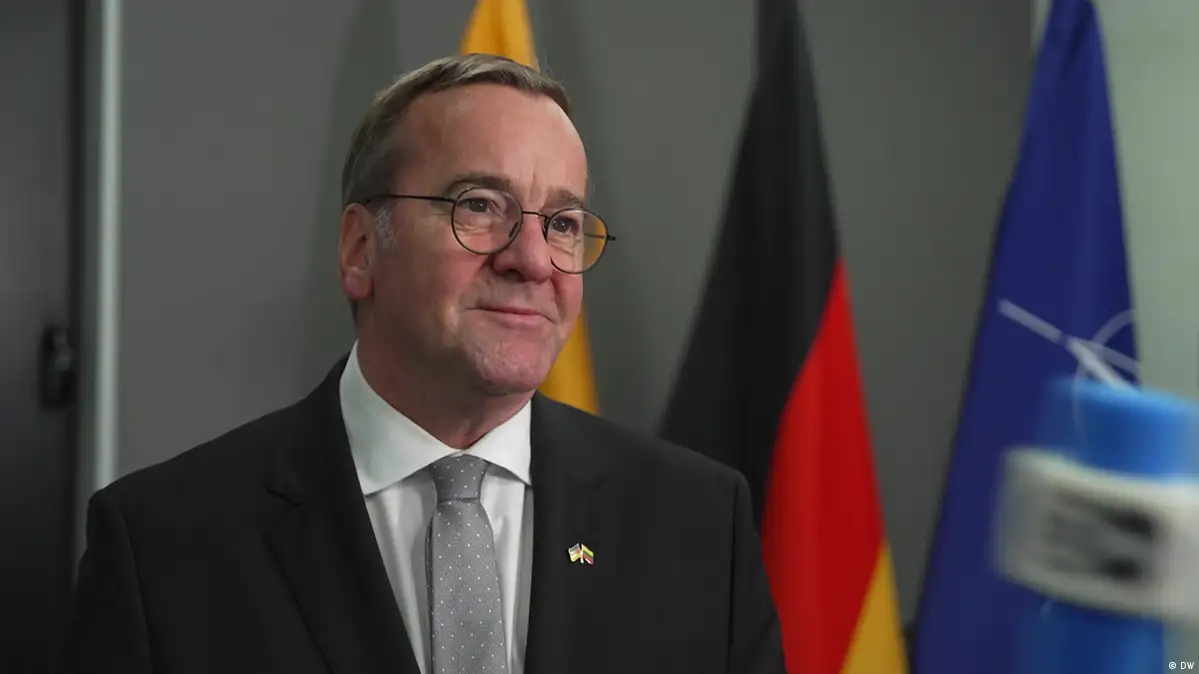
For seventy years Germany’s security has rested on NATO and European integration. Under Pistorius, Germany has moved from being a protected front-line state of the Cold War to a provider of security on the alliance’s eastern flank.
A The basics
NATO in five ideas
Article 5
Collective defence
An armed attack against one ally is considered an attack against all. Each ally then takes the action it deems necessary, including armed force. It has been invoked once, after 11 September 2001.
Deterrence
Preventing war
NATO aims to convince any adversary that an attack would fail and cost more than it could gain, through conventional forces, missile defence and nuclear weapons.
Nuclear sharing
Germany’s role
Germany takes part in NATO’s nuclear sharing: in a crisis, German aircraft would deliver US nuclear weapons. The F-35 purchase is meant to keep this role after the Tornado is retired.
Forward presence
The eastern flank
Since 2017 NATO has stationed multinational battlegroups in the Baltic states and Poland. Germany led the one in Lithuania and is now replacing it with a permanent brigade.
Force model
Ready forces
NATO’s 2023 regional defence plans assign national forces to specific regions and require far more troops at high readiness than in the past.
Spending
From 2% to 5%
The 2014 target of 2% of GDP was replaced in June 2025 by 3.5% for core defence and 1.5% for related spending by 2035.
B The partners
Six relationships that matter most
Each entry summarises documented developments during Pistorius’s tenure. Codes follow the ISO country abbreviations.
US
United States
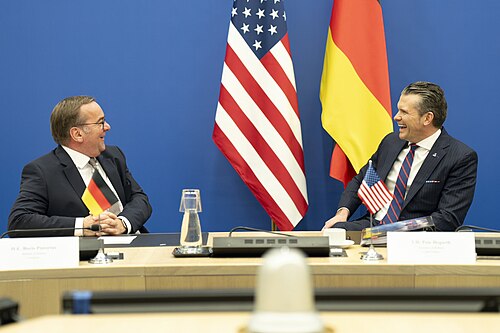
Tens of thousands of US troops are based in Germany, and Ramstein is the hub of US operations in Europe. Pistorius met Defense Secretary Pete Hegseth in February 2025, and in Munich that month publicly rejected Vice President JD Vance’s criticism of European democracies as “not acceptable”.
On 15–18 September 2026 he visited Washington, New York and Fort Worth; at the Pentagon he and Hegseth signed a memorandum of understanding on defence cooperation.
FR
France
Germany’s closest partner in the EU, but defence cooperation has been difficult. Disagreements have included the European Sky Shield Initiative and Germany’s purchase of Arrow 3, and the slow progress of joint programmes.
In September 2026 Pistorius said Berlin and Paris needed to agree “in the coming weeks” on restructuring the joint future tank programme.
GB
United Kingdom
On 23 October 2024 Pistorius and UK Defence Secretary John Healey signed the Trinity House Agreement, a landmark bilateral defence agreement covering joint capabilities, industry and the security of the North Atlantic. Since February 2025 the two ministers have co-chaired the Ukraine Defence Contact Group.
PL
Poland
Germany has deployed Patriot air defence units to eastern Poland, including to protect the Rzeszów hub through which aid flows to Ukraine. After Russian drones entered Polish airspace in September 2025, Germany contributed Eurofighter jets to NATO’s Eastern Sentry mission.
LT
Lithuania
The permanent home of Panzerbrigade 45, formally established on 1 April 2025. It is the first time the Bundeswehr has stationed a brigade permanently abroad. Lithuania awarded Pistorius its Order of Merit (Grand Cross) in 2025.
NL
Netherlands
The most integrated partnership: Dutch army brigades serve within German divisions, and the two navies cooperate closely. The 2025 NATO summit was held in The Hague.
C Transatlantic
A relationship in transition
The return of Donald Trump to the White House in January 2025 put the transatlantic relationship under strain: pressure on spending, a reduced US role in supporting Ukraine and open criticism of European governments. Pistorius has combined two messages: Europe must do far more for its own defence, and the alliance with the United States remains indispensable.
The planned stationing of US long-range weapons in Germany, the F-35 purchase and the September 2026 memorandum of understanding all reflect the second message. The record budgets and the Lithuania brigade reflect the first.
D The European Union
EU defence: from coordination to money
Defence remains a national responsibility in the EU, but the Union has gained new tools. The 2022 Strategic Compass set common goals. In March 2025 the Commission presented its ReArm Europe plan, later called Readiness 2030, including up to €150 billion in loans for joint procurement and flexibility in fiscal rules for defence spending.
Germany’s position has been to support joint European procurement and a stronger European defence industry while insisting that the EU complements NATO rather than duplicating it. The EU’s military training mission for Ukraine, in which Germany has been one of the largest contributors, shows that model in practice.