Boris PistoriusDefence · Politics · Europe
04 · Political career

Five decades in the SPD, one office at a time

Pistorius reached national office at 62 after a career built almost entirely in Lower Saxony. Each milestone below marks a change in the scale of his responsibility.

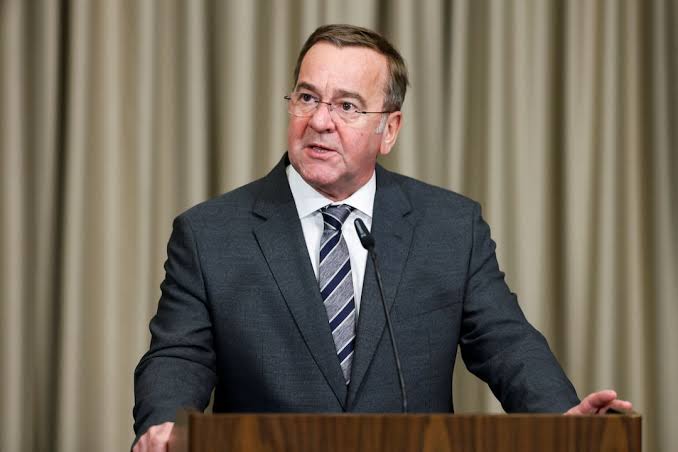
Boris Pistorius speaking at a wooden lectern in a dark grey suit and striped tie in front of a beige curtain
Fig. 1Pistorius speaking at a lectern. He is regarded as one of the SPD’s most effective public communicators.

1976–1996

Party member

A member before an office-holder

Pistorius joined the SPD in 1976 at sixteen, in a city where his mother was already a councillor. For two decades his political work ran alongside education, military service and a career as a state official in Hanover, where from 1991 he advised Interior Minister Gerhard Glogowski in Gerhard Schröder’s state government. That job gave him an early view of how an interior ministry and its police forces are run.

1996–2006

City councillor · Deputy mayor

Osnabrück city council

He was elected to Osnabrück city council in 1996 and remained a member until February 2013. From 1999 to 2002 he served as honorary second mayor, a ceremonial and representative role in Lower Saxony’s municipal system, while continuing his day job in the regional administration of Weser-Ems.

2006–2013

Lord Mayor of Osnabrück

Running a city

In 2006 Lower Saxony’s mayors were directly elected full-time heads of the municipal administration. Pistorius won the run-off on 24 September 2006 against Wolfgang Griesert of the CDU with about 55 per cent and took office on 7 November 2006. As Lord Mayor he headed both the elected council’s executive and a city administration of several thousand staff.

He left office early in February 2013 when called into the state cabinet. Griesert went on to succeed him later that year.

Lower Saxony in depth

2013–2023

State Minister, Lower Saxony

Interior and sport under Stephan Weil

Appointed on 19 February 2013, Pistorius served for almost ten years as Minister for the Interior and Sport in three cabinets led by Stephan Weil: SPD–Green (2013–2017), SPD–CDU (2017–2022) and SPD–Green again from November 2022. He also represented Lower Saxony in the Bundesrat, the federal chamber of the states.

He won the Osnabrück-West seat in the Landtag in October 2017 with 42.6 per cent of the constituency vote and held it in October 2022 with 38.9 per cent. Nationally he became known as a law-and-order Social Democrat: firm on Islamist threats and right-wing extremism, and willing to argue with his own party.

2017–2019

National party roles

The federal executive and a leadership bid

On 8 December 2017 he was elected to the SPD’s federal executive (Parteivorstand). In 2019, when the SPD let members choose a new joint leadership, he and Saxony’s integration minister Petra Köpping stood as a team. They finished fifth in the first round with about 14 per cent; Saskia Esken and Norbert Walter-Borjans eventually won.

The defeat kept him in Hanover, and it meant that he arrived in federal politics in 2023 without the factional history of the leadership contests.

2023–today

Federal Minister of Defence

Berlin

Chancellor Olaf Scholz named him Defence Minister on 17 January 2023; he was sworn in two days later. After the governing coalition of SPD, Greens and FDP collapsed in November 2024, his high approval ratings made him the subject of a public debate about whether he, not Scholz, should lead the SPD into the election. On 21 November 2024 he ruled himself out.

He was elected to the Bundestag for the Hannover II constituency on 23 February 2025 with 36.2 per cent of the first vote and took his seat on 25 March 2025. Six weeks later, on 6 May 2025, Friedrich Merz reappointed him in the new CDU/CSU–SPD government.

Federal politics in depth

The pattern of the career

Three things stand out. First, nearly all his executive experience before 2023 was in security and administration: an interior ministry adviser, a mayor, an interior minister. Second, he rose without a federal power base, which has given him unusual independence within the SPD. Third, his popularity has been built as a minister rather than as a campaigner: he had never won a federal election before 2025.